The term Agentic CMS appeared in industry discussions in mid-2026 and almost immediately made its way onto the agendas of boards and chief technology officers in the enterprise sector. However, we are not talking here about yet another simple plug-in that generates text at the editor’s request, but about the foundations for a completely new operational model in marketing. In an era of a growing number of digital channels, dynamic market localisation and constant pressure to reduce time-to-market (time-to-market), the traditional approach to content management is no longer effective.
Rather than treating artificial intelligence as a plug-in for a word processor, leading organisations are moving towards a stage where autonomous AI agents become active participants in business processes.
Key finding
- Agentic CMS represents a natural progression of the headless trend: Autonomous AI agents not only write articles at the user’s request, but also proactively carry out multi-stage tasks on structured data.
- Scaling operations without increasing staff numbers: The aim of deploying agents is not to replace creative teams, but to relieve them of repetitive, tedious tasks – from large-scale SEO audits, through localisation for dozens of markets, to verifying legal compliance.
- Quality and consistency over mass production: The true value of new technology lies not in generating mass amounts of content spam, but in maintaining an error-free, up-to-date and consistent knowledge base on products and services.
- A new dimension of the audience (AEO): Contemporary content in a CMS is designed in parallel for both humans and machines – including answer engines (answer engines), conversational bots and recommendation systems.
- Essential organisational discipline (Governance): The autonomy of agents requires built-in safeguards: human approval of key changes (human-in-the-loop), precisely assigned permissions, and a full record of actions taken.
Our experience in delivering projects for major brands clearly shows that the typical challenges associated with technology migrations – such as mounting technical debt and fragmented data repositories – present the ideal opportunity to implement an agent-based approach. Rather than building yet another passive system, it is worth automating content management right from the architecture modernisation stage.
What is Agentic CMS and how does it differ from an ‘AI-powered CMS’?
There has been a great deal of conceptual hype surrounding artificial intelligence. Most software providers label their products as ‘AI-powered’, though this usually amounts to nothing more than a simple assistant or a chat window built into a word processor. To fully understand this paradigm shift, a precise definition is required:
Agentic CMS is a content management system in which autonomous AI agents proactively monitor input data, initiate tasks and manage multi-stage business processes (workflows), operating on a structured data model and pausing at points requiring human verification.
The difference between an AI-powered solution (AI-powered) and a fully agentic system (Agentic) is not merely a question of scale – it is a fundamental change in the way work is initiated and carried out.
- A standard AI-powered CMS allows an editor to open a product form, paste in the technical specifications and click the button: ‘Generate description in Polish’. The editor must then copy this description, have it translated using an external tool, check that the SEO tags are correct and publish the product page manually.
- Meanwhile, Agentic CMS runs in the background. When the product development team adds 50 new items to the PIM system, the AI agent detects this event, retrieves the specifications, creates descriptions optimised for SEO, automatically commissions and verifies localisation for five markets, prepares product bundle suggestions (cross-sell) and generates a complete preview (staging) for rapid approval by the Brand Manager.
From Monolith to Agentic CMS: a brief history and market context
To understand why the concept of Agentic CMS is emerging right now, it is worth taking a look at the evolution that content management systems have undergone over the last two decades. Each successive era addressed the pressing issues of its time, but at the same time created new operational bottlenecks:
1. Monolithic Web CMS systems / c. 2000 /
The first web CMS systems combined databases, a business logic layer and presentation templates into a single, indivisible codebase. This solved the problem of developers having to manually edit HTML files, providing the marketing team with a basic tool for publishing content. However, flexibility became a bottleneck – any change to the website’s design required the involvement of developers.
2. Platformy DXP (Digital Experience Platforms) /c. 2010/
The growth of digital marketing has led to the emergence of Digital Experience Platforms (DXP). This involved combining content management with analytics, personalisation and e-commerce engines. Although we have gained rich ecosystems of tools, these systems have become extremely cumbersome, slow to implement and difficult to maintain.
3. Headless CMS /c. 2015/
Headless architecture has separated the presentation layer (front-end) from the content repository (back-end). Content began to be served as an API, which allowed it to be entered once and distributed across multiple channels – websites, mobile apps and in-store displays.
4. Composable architecture /c. 2020/
DXP monoliths have given way to flexible ecosystems comprising specialised microservices (API-first). The company was able to combine the market-leading CMS with a dedicated PIM system (product information management), a DAM (digital asset management) system and a search engine.
5. The introduction of AI-powered solutions and agent-based approaches /from 2024/
Composable and headless architectures solved the problem of multi-channel content distribution (omnichannel delivery). Unfortunately, they have created a new bottleneck: people. In a fragmented ecosystem of tools, marketing staff had to manually transfer data, copy context from the PIM to the CMS, commission translations, verify descriptions and ensure compliance with regulations.
According to the latest report from Contentstack, as many as 85 per cent of enterprise organisations are currently assessing whether their technology stack supports agentic use cases (agentic use cases), whilst 86 per cent are planning a major consolidation of their content platforms over the next 18 months.
How AI agents work in Agentic CMS: 5 e-commerce scenarios
1. Bulk updating and enrichment of product content
Once a new collection has been imported from the PIM system, the AI agent automatically takes the lead. It analyses the products’ technical specifications and generates short descriptions for category lists, as well as detailed, narrative descriptions for product pages. Furthermore, it creates bespoke SEO tags, proposes question-and-answer (FAQ) structures, and suggests complementary products based on historical sales data. Human involvement is limited to approving the final set of changes in the approval panel.
2. Multilingual localisation and contextual adaptation
The launch of a new campaign in the home market (e.g. Poland) automatically triggers a cascading localisation process. However, the AI agent does not simply produce a word-for-word translation. It adapts the tone of the message (brand tone) to the specific characteristics of local markets (e.g. the Czech, Slovak and German markets), checks local units of measurement and automatically verifies legal requirements (e.g. the inclusion of mandatory disclosure clauses for a given region).
3. Continuous, automated content audits (Content Audits)
In the traditional model, an audit of thousands of subpages on an enterprise website took place once a year and lasted for months. Agentic CMS carries out this process on an ongoing basis. AI agents scan the website for out-of-date promotions, expired sales, missing alternative text (ALT) in images, duplicate content and broken links. If a simple error is detected (e.g. a missing ALT tag), the agent prepares an automatic correction and submits it for approval.
4. Smart management of seasonality and availability
The agent constantly monitors the marketing campaign calendar, data from the analytics system and e-commerce stock levels. If a particular product sells out faster than anticipated, the agent proactively suggests removing its promotion from the homepage and replacing the banner with an alternative product that is readily available, whilst ensuring the continuity of SEO links.
5. Preparing content for answer engines (Answer Engines)
Traditional search engines are giving way to AI assistants (Google AI Overviews, Perplexity, ChatGPT). Agentic CMS, drawing on an internal knowledge base and guides, automatically generates structured content variants (e.g. data in JSON-LD format, FAQs, microformats) that enable generative algorithms to easily read, understand and cite the brand’s offering as an official source of answers.
Content for people and for AI: how to tailor content for new audiences
The way in which we create and structure content is undergoing a profound transformation. In 2026, the audience for content in your CMS is not just a human using a web browser. It also includes autonomous bots, recommendation engines and response algorithms. Content is no longer merely passive text formatted in HTML; it has become a digital interface for customers and input data for artificial intelligence.
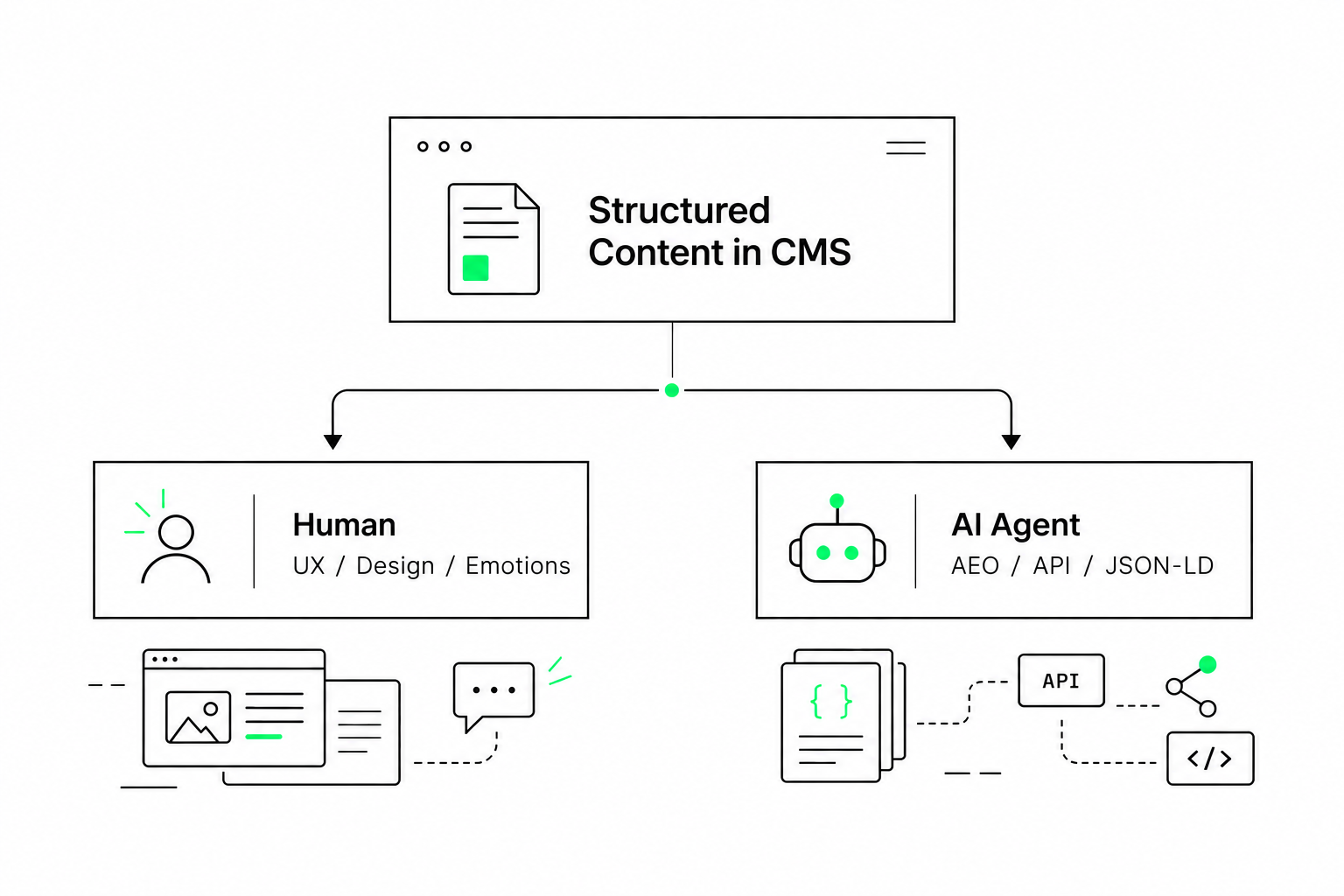
For an organisation to benefit from Agentic CMS, its content strategy must incorporate the following pillars:
- The AI-Readable approach: Data must be precisely typed (e.g. clearly distinguishing between instructions how-to guides from terms and conditions or product sheets), rich metadata and clearly defined relationships. A great example of such an architecture is the Content Lake initiative developed by Sanity, in which content is treated as a coherent, searchable knowledge graph.
- Answer Engine Optimisation (AEO): Traditional search engine optimisation (SEO) is shifting towards Answer Engine Optimisation. Generative systems cite only those sources that are consistent, logically error-free and unambiguously structured.
- Data remediation at source: Agentic CMS will not fix a chaotic information architecture. If your company has conflicting product descriptions across three different systems, implementing AI agents will only compound this chaos. The implementation of the technology must be preceded by the organisation of content models and concept vocabularies.
Agentic CMS in an enterprise architecture: integration and ecosystem
Agentic CMS does not require the existing IT infrastructure to be dismantled. Its strength lies in its ability to create an intelligent orchestration layer on top of the existing ecosystem of tools.
- The modern enterprise ecosystem is built on stable pillars:
- Headless / Composable CMS (e.g. Magnolia, Adobe Experience Manager, Contentful): It acts as a central content repository and is responsible for serving content via an API. AI agents operate directly on this layer through exposed application programming interfaces.
- Integration with PIM, DAM and e-commerce systems: For an agent to make accurate decisions, it must have the full business context. Platforms such as Payload CMS provide full control over database structures, whilst solutions such as Storyblok facilitate marketing automation without the need to involve engineers.
- Regional challenges (CEE and global markets): Many organisations in Central and Eastern Europe manage multiple brands and markets with differing legal requirements (e.g. the financial and pharmaceutical sectors). Agentic CMS is ideally suited to such environments, provided that the business rules have been correctly mapped.
Governance, security and compliance in Agentic CMS
In an enterprise environment, it is not the ‘magic of AI’ itself that is key, but the ability to exercise full control over processes: a precise understanding of who, when, on what data and within what limits a particular decision was made.
Granting autonomy to agents without appropriate safeguards would constitute an unacceptable operational risk. That is why the secure Agentic CMS is based on four pillars of security:
- Human-in-the-Loop model: AI agents independently plan, generate, verify and assemble the components into a whole; however, final publication in the production environment requires physical approval by a designated member of staff (brand owner, lawyer or marketing manager).
- Context-based permissions (Permission-bound execution): The AI agent has an identity and scope of permissions analogous to those of an employee. The agent responsible for the Czech market does not have the technical capability to publish changes on the German market or to modify global legal templates.
- Full auditability and version control: Every decision, change and recommendation made by the agent is logged. The system maintains a history of prompts, input data and quality tests, enabling changes to be rolled back immediately should an error be detected.
- Regulatory compliance (EU AI Act): From 2 August 2026, key provisions of the EU Artificial Intelligence Act (EU AI Act) will come into force. These provisions require companies to ensure transparency and human oversight of systems that use AI. Agentic CMS provides a ready-to-use infrastructure that meets these legal requirements.
How to get started: a large organisation’s journey to Agentic CMS
Process re-engineering in a large company should not be carried out using a ‘big bang’ approach. We recommend a safe, phased implementation path based on experience gained from enterprise projects:
Step 1: Operational diagnosis and audit
Map out your current processes from the moment the brief is created right through to publication. Identify the areas where staff are acting as ‘human glue’ – copying data between systems, manually checking emails and completing checklists.
Step 2: Organising the information architecture
Standardise content types, glossaries and metadata. Define clear guidelines on brand tone (brand tone) and legal principles in the form of unambiguous business rules.
Step 3: Selecting a pilot process
Identify a single, repeatable process with limited risk and a clear business owner (e.g. the automatic localisation of product pages for a single new market, or an automated audit of missing ALT text and meta descriptions).
Step 4: Carrying out the PoC (Proof of Concept)
Design and implement a pilot scheme using AI agents. Introduce a clear human-in-the-loop model and define success metrics (e.g. a reduction in the number of hours required to launch a new product card).
Step 5: Scaling and building your own memory
Following a successful pilot, roll out agent-based workflows to further markets, brands and channels. Bear in mind that, over time, the organisation builds up its own unique operational memory, becoming independent of specific model providers or SaaS tools.
Frequently Asked Questions (FAQ)
Does Agentic CMS mean that AI will replace the content team
No. Agentic CMS eliminates the most repetitive, tedious and routine tasks from your daily workflow (such as manual tagging, copying descriptions, bulk updates or checking for typos). However, it does not replace creative and strategic roles – such as content strategists, creative directors, lawyers or product managers. In practice, teams regain time to analyse customer needs, experiment with new formats and build brand strategies.
How long does the transition from a traditional CMS to an agent-based approach take
The implementation timeframe depends on the company’s level of digital maturity. Preparing the first proof of concept (PoC) covering a single specific process takes anywhere from a few to a dozen or so weeks. A full transformation of the ecosystem within a large enterprise organisation typically takes between 6 and 18 months and should be carried out in stages.
Do we need to replace our current headless CMS
In the vast majority of cases, there is no need to do so. If your current CMS has a headless/composable architecture and mature APIs, an agent layer can be built on top of it. The key step is to audit the data models and the efficiency of the integration, rather than replacing the entire system.
What new skills does the marketing team need to acquire
Employees do not need to learn to programme. Process-related skills are key: precisely defining objectives and guidelines for agents, working with structured data models, and the ability to analyse operational reports generated by AI.
How can you estimate the return on investment (ROI) for Agentic CMS
Calculating ROI is based on an analysis of time and costs: map out the number of hours your team spends each month on manual data transfer, translations, corrections and audits. Compare these costs with the quote for implementing agent-based orchestration. According to data from OpenAI Enterprise Signals, over 64 per cent of the tokens used by companies are spent on complex, multi-stage agent tasks, which generate direct operational savings.
Author
Michał Połetek
IT Client Partner
A Client Partner with extensive experience in business development, built on strong relationships.
He has been involved in the technology sector since the start of his career – he took his first steps as the founder of his own start-up, before going on to gain experience in roles as Product, Project and Marketing Manager.
At SYZYGY, he is responsible for building partnership-based relationships with clients and delivering tangible business value. In his work, he is guided by a simple motto: “How can I help?”


Would you like to test the potential of Agentic CMS in a secure pilot scheme
Test how AI agents perform on a single, selected business process – without having to replace your entire IT infrastructure straight away. Let’s carry out an initial PoC project tailored to your organisation’s objectives and challenges.