
AI Strategy, UX Research, Product Design & AI Development
AI designed for everyday wor
A global manufacturer of building materials wanted to find out whether an AI Assistant could genuinely support professional contractors in their day-to-day work whilst also enhancing the value of its loyalty programme. Rather than starting by building a solution, we worked with the client to identify the users’ key challenges and assess where AI could deliver the greatest business value.
The project covered the entire process: from product strategy, qualitative and quantitative research, and Product Discovery workshops, through to the design, implementation and validation of the AI Assistant Proof of Concept.
The challenge
A loyalty scheme that offers more than just benefits
The loyalty programme was designed to help build long-term relationships with professional contractors; however, the client wanted to offer users more than just a standard benefits scheme. They were looking for a solution that would genuinely make day-to-day work easier: from preparing quotes and selecting products to quick access to technical expertise. An AI assistant seemed a natural direction to take, but before committing to the investment, it was necessary to verify whether it would actually meet users’ needs and add value to their day-to-day tasks.
Day-to-day work isn’t like it is in an office
The first step was to understand how professional contractors work. Research showed that quotations are often prepared away from the job site, after work has finished or during breaks between client meetings. The process involved manually calculating material quantities, comparing products and consulting numerous scattered sources of information. In many cases, contractors relied on Excel spreadsheets, simple calculators or their own tools developed for their day-to-day work.
Answer the right questions first
Research has also shown that users do not expect a complex quotation system. They need a simple tool that will allow them to quickly prepare a quote, select the right product and minimise the risk of error – ideally whilst still talking to the customer. Before we began the implementation, we wanted to address a few key questions together with the client.
- Will AI really reduce the time taken to prepare quotations?
- Will users trust the recommendations generated by the AI Assistant? And which features will have the greatest impact on their day-to-day work?
The answers to these questions were to determine not only the form of the Proof of Concept, but also the direction of the product’s future development.
The quotation software should be as simple as a calculator, so that I can draw up a quote whilst I’m still talking to the client.
Our approach
1. Understand the problem before implementing AI
Rather than starting the project by implementing an AI solution, we focused on understanding the day-to-day work of professional contractors and identifying the areas where an intelligent assistant could deliver the greatest value. Our aim was not to create yet another chatbot, but to develop a solution that addressed users’ specific challenges and aligned with the client’s business objectives.
We began the project with the Product Discovery phase, which involved qualitative and quantitative research, an analysis of existing materials, and workshops attended by the business, design and technology teams. This enabled us to identify the users’ key problems, validate business hypotheses and define scenarios in which the use of AI offered the greatest potential.
2. Designing a data-driven solution
We organised the findings from the research using the Opportunity Solution Tree, which enabled us to translate user needs into specific scenarios for using the AI Assistant. Rather than developing multiple features simultaneously, we focused on those that could deliver the greatest business value whilst also being validated as part of a Proof of Concept.
On this basis, we designed and implemented a Proof of Concept for an AI Assistant to support the preparation of quotations, product selection and access to product knowledge. The solution was deliberately limited to the most important use cases, enabling us to quickly verify key hypotheses and gather valuable feedback from users.
3. Validation with end users
The final stage involved validating the solution with professional practitioners. The tests made it possible to assess not only the quality of the responses generated by the AI Assistant, but above all whether it genuinely facilitates day-to-day work and meets users’ needs. The observations gathered formed the basis for recommendations regarding the product’s further development and the preparation of the next stages of implementation.
The AI assistant has been designed to support professional contractors from the client’s very first enquiry right through to the preparation of a final quo
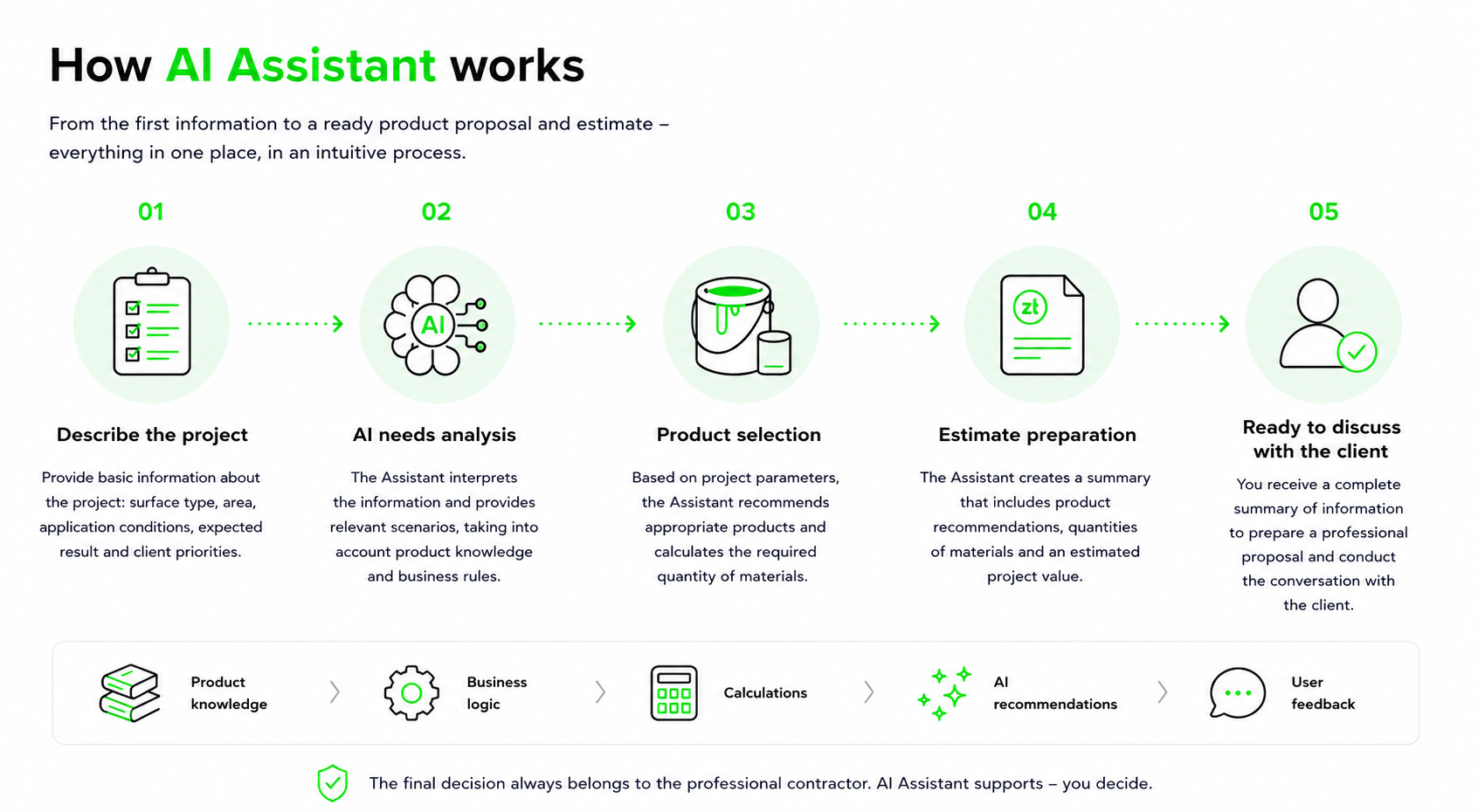
How the AI Assistant works: from project analysis to product recommendations and preparing a quote
Solution:
AI assistant to help prepare quotations
The project resulted in the creation of a proof of concept for an AI assistant designed with the day-to-day work of professional tradespeople in mind. The solution focused on one of the most time-consuming stages of their work – preparing quotes and selecting the right products to meet the client’s needs.
The assistant guides the user through the process of preparing a quote, gathering information on, amongst other things, the type of surface, floor area, application conditions and the expected end result. On this basis, it prepares a product recommendation, estimates the quantity of materials required and generates a ready-to-use summary that can be used during a discussion with the customer.
The solution has been deliberately limited to the most important use cases in order to enable rapid validation of business hypotheses.
AI as a decision-making aid, not a substitute for decisions
The solution has been designed to support the user at every stage of preparing a quotation, whilst leaving the final decisions to the contractor. Rather than replacing expert knowledge, the AI Assistant helps to analyse the available information more quickly, reduces the number of manual calculations and facilitates access to product knowledge. This approach allowed us to focus on genuinely improving users’ day-to-day work, rather than building a complex system with features that were not necessary to validate the solution’s value.
Proof of Concept designed for rapid validation
From the outset, we assumed that the aim of the project was not to create a complete product, but to validate the most important business hypotheses. For this reason, the Proof of Concept was deliberately limited to key usage scenarios and the minimum functional scope necessary to carry out user testing. This approach made it possible to obtain feedback quickly, assess the quality of interactions with the AI Assistant, and identify areas requiring further development before work began on the production version. At the same time, it helped to minimise the costs and risks associated with implementing a complex solution at too early a stage of the project.
The project in figures
Result
A validated strategy for the development of an AI product
The proof of concept confirmed that the AI Assistant can effectively support professional contractors in preparing quotations, selecting products and accessing technical knowledge. At the same time, the project helped to identify areas requiring further refinement before the start of full-scale implementation. Thanks to user testing, the client received not only a working solution, but above all verified data enabling them to plan the next stages of product development with confidence


The project demonstrated that the successful implementation of AI begins with understanding users, rather than choosing a technology. By combining research, product design and validation with end users, the client received not only a proof of concept for the AI Assistant, but also a solid basis on which to make decisions regarding the solution’s further development.
Do you want to create an AI solution that genuinely supports users?
Use AI to solve a specific business problem
From Product Discovery workshops and the identification of use cases, through to Proof of Concept and production deployment. We help design and develop AI solutions that address users’ real needs and support the achievement of business objectives.