The e-commerce market is growing at a pace that would have seemed unimaginable just a decade ago. This article is intended for online shop owners, e-commerce managers and anyone interested in modern online sales technologies. In this article, we explain what headless e-commerce is, how it works and why you should consider implementing it in your business. Customers no longer shop exclusively via desktop computers. They use smartphones, mobile apps, social media, voice assistants and even smart home devices (IoT). In this multi-channel world, traditional, monolithic sales platforms are beginning to resemble a restrictive straitjacket that hinders the growth of dynamic brands.
To keep pace with consumers’ growing expectations regarding speed and convenience when shopping, market leaders are adopting a new technological approach. The solution that redefines flexibility and scalability in digital commerce is headless e-commerce.
In this article, you’ll find out exactly what headless architecture is, what benefits it offers your business, and why this model is shaping the future of modern online retail.
How does headless e-commerce work? The architecture explained in simple terms
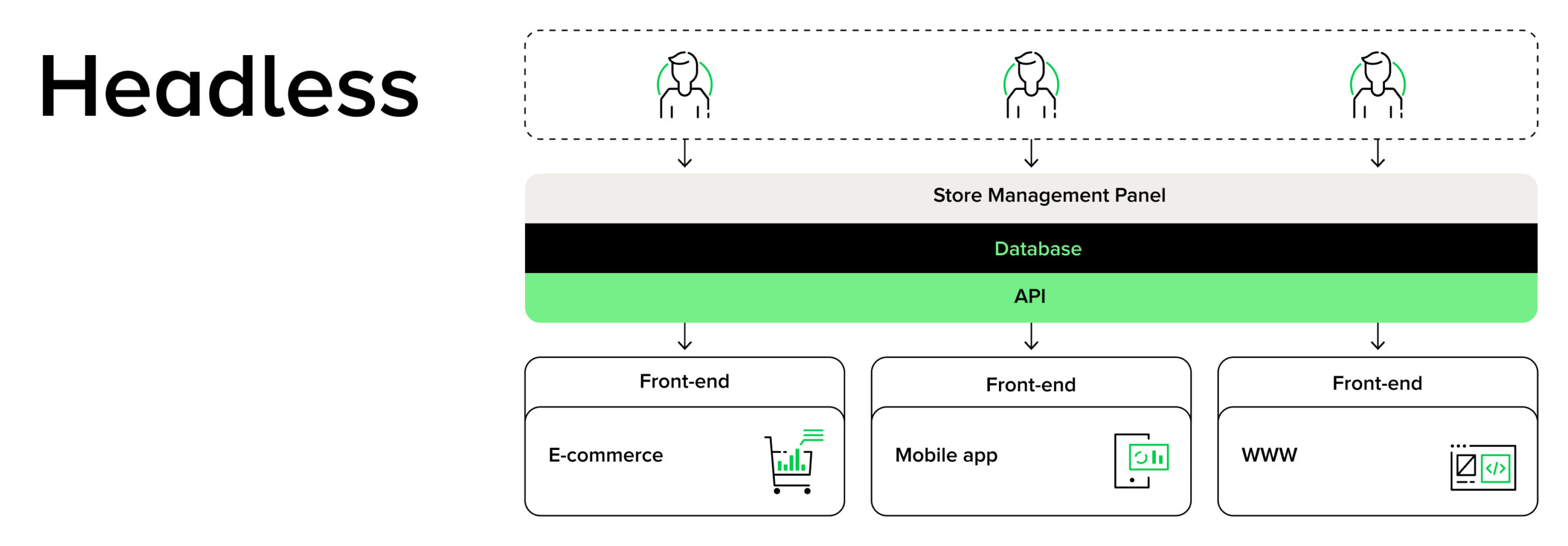
Headless e-commerce is a modern online shop architecture that separates the front-end from the back-end of the application, with communication between these layers taking place via APIs.
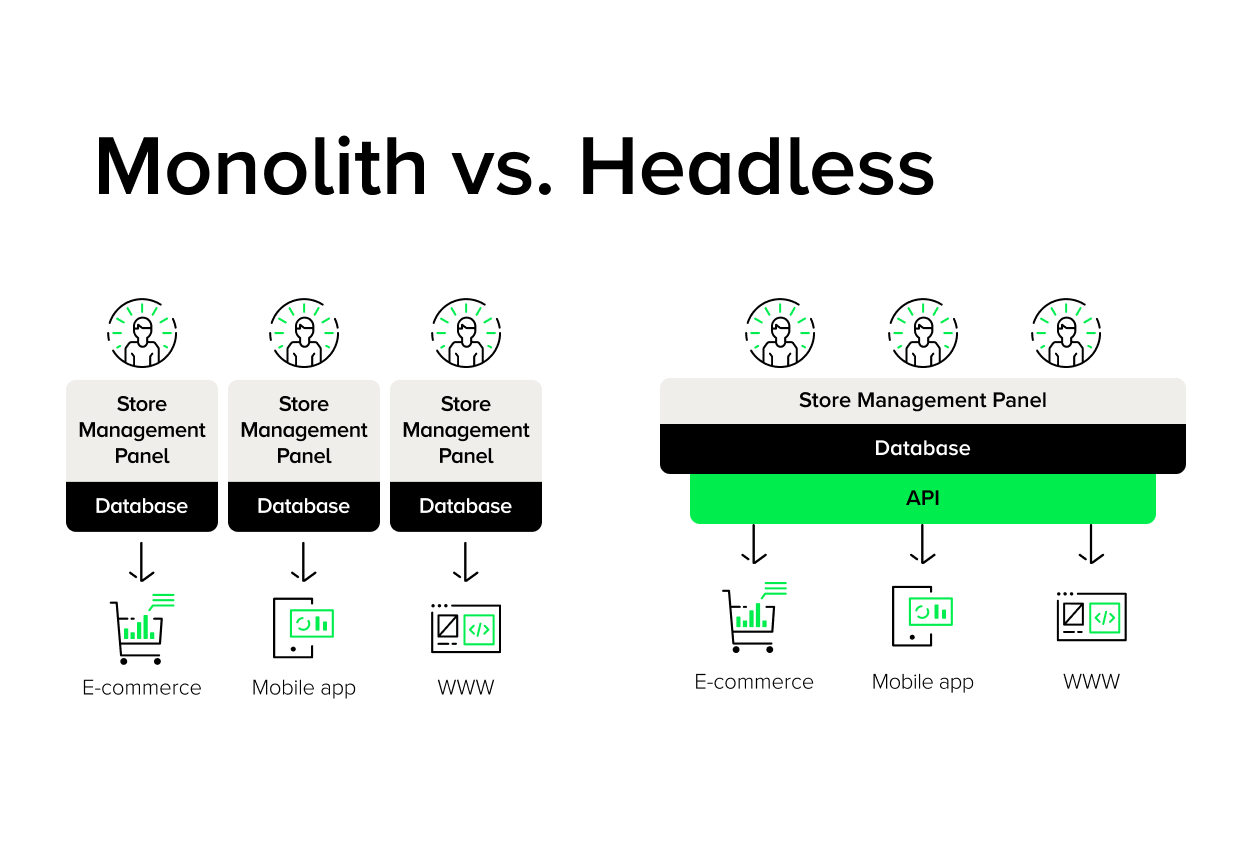
To understand the phenomenon of headless architecture, we must first look at how a traditional online shop is built. In the classic model (the so-called monolith), the visual layer that the customer sees (the frontend) and the system managing the database, orders and payments (the backend) are inextricably linked. A change in one element almost always requires intervention in the other.
In headless e-commerce, we separate the ‘head’ (i.e. the frontend) from the ‘body’ (i.e. the backend). These two layers become independent entities that communicate with each other via an application programming interface, or API (Application Programming Interface).
A restaurant analogy: Understanding headless in 3 minutes
Imagine visiting an upmarket restaurant:
- Backend: This is where all the magic happens – chefs prepare dishes, store ingredients and manage logistics. In e-commerce, it’s the engine of your shop: the product database, the promotions engine, and the order and payment system.
- The customer’s space (Frontend): This is the space where the customer sits. It could be a cosy restaurant dining room, a summer garden, or even a home delivery. In the digital world, it’s a web browser, a smartphone app, a screen in a high-street shop, or a smartwatch app.
- Waiter (API): This is the key link. They take orders from the table (the front end), pass them on to the kitchen (the back end), and then bring the finished dish back to the customer.
With this separation, you can completely overhaul the restaurant’s interior design (frontend) without having to reorganise the chefs’ workflow or rebuild the kitchen (backend). This is exactly how headless e-commerce works.
Headless e-commerce vs. traditional e-commerce (monolithic)
Choosing the right technology is one of the most important strategic decisions for any E-commerce Director or CTO. Although monolithic systems still work well for smaller, standard implementations, as a business scales up, they begin to generate high maintenance costs and stifle innovation.
The table below outlines the key differences between these two approaches:
The key benefits of implementing headless e-commerce for businesses
The move to a headless model is not just a technological trend – it is, above all, a strategic business decision that has a direct impact on conversion rates and return on investment (ROI). Here are the key benefits of headless architecture.
1. Lightning-fast page loading speeds and improved SE
Time is money, especially in online retail. Every second of delay in page loading drastically reduces conversion rates and increases bounce rates. Traditional e-commerce platforms often struggle with the problem of bloated code.
In headless e-commerce, the frontend can be built as an extremely lightweight single-page application (SPA) or using static site generation (SSG). This translates into excellent results in Google Core Web Vitals tests. Search engines favour fast, stable websites, which directly improves your shop’s ranking in search results.
2. Unlimited freedom and an excellent user experience (UX
In the traditional model, designers and UX specialists have to adapt their visions to the constraints of a given platform’s template. In the headless world, these constraints disappear. You can design a unique shopping journey, experiment with unconventional layouts, and personalise content for specific audience segments. Your brand gains a complete visual identity without any technological compromises.
3. True omnichannel and brand consistenc
Today, customers can start shopping on Instagram, continue on their laptop, and complete their purchase in a physical store using an interactive kiosk. Thanks to headless architecture, you don’t need to create separate databases or duplicate content management systems. All information about products, prices and stock levels is stored in a single backend, and the API distributes it to any device. This ensures consistency in the product range and brand image at every customer touchpoint.
4. Faster time-to-market for new features
In a fast-paced market environment, success goes to those who can respond to trends the quickest. If you want to implement new functionality (such as a new deferred payment system or a personalised product recommender), with a headless model you can do so without worrying about destabilising the database or checkout engine. Development teams can work independently – front-end developers implement new visual features, whilst the back-end team optimises logistics processes.
5. Safety and MACH’s modern philosoph
Headless e-commerce is part of the modern MACH standard (Microservices, API-first, Cloud-native, Headless). Distributed architecture enhances the security of the entire system. Even if the presentation layer fails or becomes overloaded during a major sale, sensitive customer data and transactional processes in the backend remain secure and intact.

Challenges and drawbacks of headless architecture
As a reliable technology partner, we at SYZYGY always prioritise transparency. Headless architecture, despite its many advantages, is not without its challenges. Before deciding to migrate, it is worth considering the following points:
- Higher initial costs (CAPEX): Building two separate systems (front-end and back-end) from scratch requires a greater financial outlay at the outset than launching a ready-made template on a traditional platform.
- Technical complexity: Managing a distributed architecture requires specialist knowledge. Your company will need support from qualified developers or an experienced external agency.
- No default live preview (WYSIWYG): In some simple headless systems, marketers may lose the ability to easily preview changes to the page in real time. However, this issue can be resolved by implementing modern headless CMS systems (such as Storyblok or Contentful).
That is why it is so important to undertake the digital transformation process with a partner who can calculate the total cost of ownership (TCO) and select the appropriate technology stack.
Who is headless e-commerce the best choice for?
The headless model is not a one-size-fits-all solution for every small business just starting out online. It is a technology designed for companies with specific needs and a certain scale of operation.
Headless e-commerce is the ideal solution for:
- Mature e-commerce brands that have reached a technological ceiling on their current monolithic platform and are experiencing a decline in performance as traffic grows.
- Companies implementing an advanced omnichannel strategy that sell through multiple channels and wish to manage their product range from a single, central location.
- Marek, who prioritise a unique user experience and design, for whom the standard look of shop templates is insufficient for positioning a premium brand.
- Companies with complex logistics (B2B and B2C), requiring the integration of their online shop with a range of external systems such as ERP, PIM, WMS and CRM.
How can SYZYGY help you with your transition to a headless architecture?
Implementing headless e-commerce as a service is not just a matter of changing the code – it is a transformation of the way your business communicates with customers. At SYZYGY, we combine a deep understanding of business processes with the highest level of technological expertise.
What are the benefits of working with us?
- A bespoke design approach: We analyse your current infrastructure and business objectives to select the most suitable tools (e.g. commercetools, Shopify Plus as a headless solution, Storyblok or Contentful).
- An experienced team of engineers and UX designers: We create fast, responsive and beautiful front-end interfaces that engage users and deliver a real boost to conversion rates.
- Secure data migration: We ensure a smooth transition from a traditional system to a headless model, without any disruption to sales and whilst taking care to preserve your existing SEO rankings.
- Post-implementation support: We ensure the ongoing development of your system, optimise its performance and integrate it with new tools as your business grows.

Are you struggling to manage multiple sales channels
Our headless e-commerce implementation service could be the solution to your challenges.
Gain flexibility and scalability. Share your email address with us – we’ll arrange a meeting to discuss how headless e-commerce can support your business’s growth and meet your customers’ rising expectations.