

Sulu implementation
Sulu CMS is a modern content management system based on the Symfony framework, designed for organisations that need a scalable and flexible platform for developing websites, content platforms and multisite environments.
It combines the convenience of a traditional CMS with the capabilities of a headless architecture, enabling the creation of both classic websites and modern omnichannel solutions.
At SYZYGY, we design and implement Sulu CMS solutions tailored to business processes, system integration and the requirements of editorial and marketing teams.
What needs does Sulu meet?


Sulu CMS experts
At SYZYGY, we design and implement Sulu CMS solutions for organisations requiring a stable, scalable and adaptable content platform. We combine expertise in technology, UX, information architecture and content strategy to create systems tailored to both business needs and the day-to-day work of editorial teams.
We support our clients at every stage of the project – from Discovery workshops and solution architecture through to development, integration and platform maintenance.

Are you thinking about implementing Sulu?
Leave us your email address and phone number – we’ll call you back within 24 hours to discuss your needs and the challenges involved in implementing this CMS. Let’s see if Sulu CMS is the right solution for your team, editorial processes and technical architecture.
Who will be working for you?
In our approach to projects, we prioritise transparency and direct collaboration. This means that right from the very first discussions about your project, you’ll have the opportunity to meet the team members who will be directly involved in its implementation. We avoid the practice of ‘putting staff on display’ – the people you speak to are the very same ones who will be working on your project. This means that from the very start, you know who you are working with, and we can better understand your needs and expectations.
We assign each client a dedicated team of specialists who focus exclusively on their project. This approach guarantees not only a better understanding and commitment, but also significantly better results than in a model where staff work on several projects simultaneously. By agreeing a fixed rate in advance, we ensure cost transparency – we eliminate hidden charges and underestimation of the scope of work, which are often a problem in fixed-price models.
Our approach to team building ensures the equal involvement of all team members at every stage of the project. This ensures that every individual, regardless of their role and specialism, understands and identifies with your challenges and needs. Such collaboration fosters better communication and a more effective understanding of your expectations, which directly contributes to the project’s success.
Your new content management system: How do we work?
Starting a partnership with us is more than just signing a contract. We ensure that the entire process is perfectly tailored to your company’s needs. We guide you step by step through the stages of the project so that the Enterprise CMS we implement not only meets your expectations but also helps you achieve your business goals.
↘︎ Step one: Discovery phase
The Discovery Phase is a crucial stage that allows us to understand your company’s specific needs in the context of implementing an Enterprise CMS, such as Sulu or Magnolia. During this stage, we not only identify key business requirements, but also explore how best to leverage the capabilities of these advanced CMS systems to support your objectives.
Benefits of carrying out the Discovery phase:

- A shared understanding of business requirements
Are you wondering what new lead generation opportunities the system can offer? What conversion rates should be achieved? How should the system handle peak sales volumes? We define your goals and needs in detail to ensure that all parties share the same understanding of the project’s success. This helps us determine which features will be most useful and what performance metrics are required.
2. Tailoring the system to your needs
The specific nature of systems such as Sulu or Magnolia requires a thorough understanding of both your expectations and those of your customers. Through an initial analysis and assessment, we can avoid the risk of implementing a system that would fail to meet your company’s actual requirements.
Check out “Which CMS to choose – a comparison based on accessibility”.



3. Rapid testing and prototyping
We can quickly create a Proof of Concept and test key features, allowing for early fine-tuning and optimisation of the system prior to full implementation.
4. Project cost optimisation
Careful planning and the definition of requirements at an early stage improve efficiency and reduce implementation time, which directly leads to lower costs for the entire project.


5. A basis for future decisions
Once the Discovery phase is complete, we provide a comprehensive report that serves as a solid foundation for future project decisions. This strategic approach enables long-term planning and adaptation as your business grows.
6. Confirmation of the projected budget
Based on the results of the Discovery phase, we are able to accurately estimate the future implementation costs. This gives you financial clarity and enables you to manage the project budget more effectively.
The Discovery Phase is not only a time to understand the technical requirements, but also an opportunity to lay the foundations for a lasting and effective partnership, which is crucial when implementing complex CMS systems.

Many clients consider it too risky to sign an implementation contract with a company that only wants to confirm the budget after the Discovery phase. We fully understand this, which is why our services also include the Discovery phase itself, following which you will receive ready-to-use material for preparing a request for proposal (RFP). Thanks to a precisely defined backlog and all the other artefacts from the Discovery phase, your company will be able to launch a tender, invite other companies to bid, and compare ‘apples with apples’ in the proposals.

↘︎ Step two:
Implementation of a new CMS
Design and planning
Based on the information gathered, we draw up a detailed implementation plan. This plan covers the selection of the Enterprise CMS we will use, the system architecture design, the integration strategy with other systems, and the implementation schedule. Together with you, we review the preliminary interface designs created by our UX/UI team based on research and data, to ensure that they are not only functional but also effectively guide users, for example, through the purchasing process.
Development and implementation
We begin the process of installing and customising the selected Enterprise CMS to meet your company’s specific needs. At this stage, our developers design and implement bespoke modules and features that extend the system’s capabilities, tailoring them precisely to your organisation’s requirements. We do not focus solely on technical details — it is equally important to us that the platform’s design is consistent with your brand image. Further development of the system also involves implementing solutions, testing them during your company’s day-to-day operations, and continuously improving them based on the feedback we receive from you.
Systems integration
We integrate the CMS with your existing business applications, such as ERP and CRM systems or analytics tools. This allows data to flow easily between systems (ideally without your team having to intervene), thereby boosting operational efficiency. Our experience in integrating complex systems enables us to quickly resolve any issues and ensure that all tools work seamlessly together.

Data migration
If you are switching from another CMS to a new one, we handle data migration. Our team carefully plans and executes the migration process to ensure that all relevant information, including user data, content and configuration settings, is transferred securely. We provide comprehensive support and monitoring throughout the process, minimising downtime and the risk of data loss.
Testing and training
Before the official launch of the system, we carry out a series of tests designed to identify and rectify any errors. We also organise training sessions for your staff so that they can use the new tool effectively. This approach allows for a faster market launch, as staff are better prepared to use the new CMS right from the start.
Go live
The next stage is the ‘go-live’, i.e. the launch of the CMS into production. At this stage, we can either conclude our collaboration or proceed to step three.

↘︎ Step three: Maintenance and development
Once your CMS has been implemented, our work doesn’t stop there. Depending on your needs, we offer further optimisation and development, which we carry out within the scope of an additional budget.
We provide ongoing technical support, allowing your team to focus on day-to-day business operations without having to worry about the technical aspects of the system. We regularly update the CMS and introduce new features based on ongoing performance analysis and feedback received. These measures ensure that the system effectively supports the growth and achievement of your company’s business objectives.
Management of multilingual digital platforms
Modern CMS platforms must support not only content publication, but also the effective management of multiple websites, language versions and consistent communication across different markets.
Sulu CMS works well in multisite environments and organisations operating globally, enabling centralised content management and flexible scaling of digital platforms.

How much does it cost?
The cost of implementing Sulu CMS depends on the scale of the project, the scope of functionality, the number of integrations, infrastructure requirements and the level of customisation. The open-source version of Sulu itself does not require any licence fees, so the main costs of the project relate to analysis, architecture, development, integration, content migration, testing, implementation and subsequent maintenance.
The valuation is influenced by, among other things:
- multisite architecture and multilingualism,
- the number of content components,
- integration with external systems,
- the level of backend customisation and workflow,
- data migration and SEO requirements,
- maintenance and development of the platform following its implementation.
For simpler projects, Sulu can be a cost-effective alternative to commercial CMS systems. In more complex implementations, the bulk of the budget is taken up by design, architectural and integration work, particularly if the CMS is to form part of a larger digital platform.
FAQ
- What is Sulu CMS?
Sulu CMS is a modern content management system based on the Symfony framework, designed for organisations requiring a flexible and scalable platform for building websites, portals and multisite environments.
It combines the convenience of a traditional CMS with the capabilities of a headless architecture, enabling it to support both classic websites and modern omnichannel solutions. Thanks to its open architecture, Sulu is well suited to projects requiring integration with other systems, custom workflows, and the adaptation of the CMS to an organisation’s business processes.
- Who would Sulu CMS be a good choice for?
Sulu CMS is a good solution for organisations that need greater flexibility than is offered by typical SaaS platforms or off-the-shelf CMS systems based on plugins.
The system is well suited to projects requiring a bespoke information architecture, complex system integrations, the management of multiple websites and language versions, and full control over the infrastructure and platform development. Sulu is often chosen by enterprise organisations and companies developing complex content platforms and multisite environments.
- Is Sulu CMS an open-source system?
Yes. Sulu CMS is an open-source solution, which means it offers considerable freedom in terms of development and eliminates dependence on a single technology provider.
The organisation retains control over the source code, hosting, integrations, and how the platform is maintained and further developed. The open-source model also makes it easier to adapt the system to specific business requirements and avoid the limitations typical of closed SaaS platforms.
- Does Sulu CMS require licence fees?
The basic version of Sulu CMS is available as open-source software and does not require any licence fees for use.
The project costs primarily stem from analysis, solution architecture design, development, integration, data migration, and the ongoing maintenance and development of the platform. The final scope of work depends on the level of customisation, the number of integrations, and the scale of the multisite environment.
- Can Sulu CMS function as a headless CMS?
Yes. Sulu CMS can operate in headless mode and deliver content via an API to various digital channels.
This makes it possible to integrate Sulu with modern front-end frameworks such as React, Next.js, Vue or Angular. At the same time, the system retains the user-friendly administrative interface typical of traditional CMSs, which is why it is often used as a hybrid CMS solution – combining the ease of use for editorial teams with the flexibility of modern front-end architecture.
- Is Sulu CMS suitable for enterprise projects?
Yes. Sulu CMS is well suited to enterprise projects requiring scalability, security, system integration and the ability to adapt the platform to organisational processes.
The system is based on the Symfony framework, which is widely used in enterprise PHP environments, providing a stable technological foundation, the ability to develop custom features, and greater control over the solution’s architecture. Sulu is often chosen for projects involving multisite functionality, multilingual support and complex content management platforms.
- Does Sulu CMS support multisite and multilingual functionality?
Yes. Sulu CMS allows you to manage multiple websites and language versions from a single administrative interface.
This enables organisations to centralise content management, maintain consistent communication across markets, and manage complex content structures more easily. Multisite and multilingual capabilities are particularly well suited to organisations operating in multiple markets or managing multiple brands.
- Can Sulu CMS be integrated with other systems?
Yes. The open architecture of Sulu CMS allows for integration with solutions used in the modern digital ecosystem, including:
- e-commerce platforms,
- CRM,
- PIM and DAM
- marketing automation,
- analytical systems,
- AI solutions,
- login systems and SSO.
By using Symfony and an API-first approach, it is possible to build flexible composable architecture environments tailored to the organisation’s needs.
- How does Sulu CMS differ from SaaS CMS platforms?
Unlike many SaaS CMS platforms, Sulu gives organisations full control over the code, infrastructure and development of the solution.
The open-source model offers greater architectural flexibility, the ability to integrate with any system, and freedom from vendor lock-in. At the same time, implementing Sulu requires the necessary technical expertise or collaboration with a partner experienced in Symfony and enterprise CMS architecture.
- How does Sulu CMS differ from WordPress?
WordPress works very well for simpler marketing websites and projects based on ready-made themes and plugins. Sulu CMS, on the other hand, has been designed for more complex enterprise environments and projects requiring greater architectural control.
Sulu offers greater development flexibility, easier management of complex content structures, and a more predictable architecture based on Symfony. As a result, it is well suited to organisations developing complex content platforms, multisite environments, and solutions requiring integration with multiple business systems.
- What does the migration to Sulu CMS involve?
Migration to Sulu CMS begins with an analysis of the organisation’s current environment, content architecture and integrations.
As part of the process, we assist with tasks such as mapping data models, migrating content and media, preserving SEO, and reorganising editorial workflows. In many cases, migrating to Sulu CMS also provides an opportunity to address technical debt and modernise the entire digital ecosystem.
- Is a Symfony developer required for the development of Sulu CMS?
Yes – knowledge of Symfony is a major advantage when developing and maintaining a platform based on Sulu CMS.
As the system is based on the Symfony ecosystem, organisations benefit from mature development standards, a predictable application architecture and easier long-term code maintenance. This makes Sulu a good fit for enterprise environments that use PHP and modern development practices.
- How does SYZYGY support Sulu CMS implementations?
At SYZYGY, we deliver end-to-end Sulu CMS implementations: from strategy and solution architecture through to development, integrations and platform maintenance.
We support organisations in analysing business needs, designing content architecture, implementing modern front-end solutions, data migration and system integrations. We combine our expertise in Symfony, modern front-end technologies and composable architecture with practical experience in delivering enterprise projects and content platforms for large organisations.

Let’s talk about the expected results
Leave us your email address and we’ll arrange a meeting. We understand that implementing a new CMS can be complex and challenging. Our aim is to understand your needs and tailor a solution that will streamline your operations and boost efficiency. We’ll get in touch within 24 hours to discuss the details and plan the next steps.

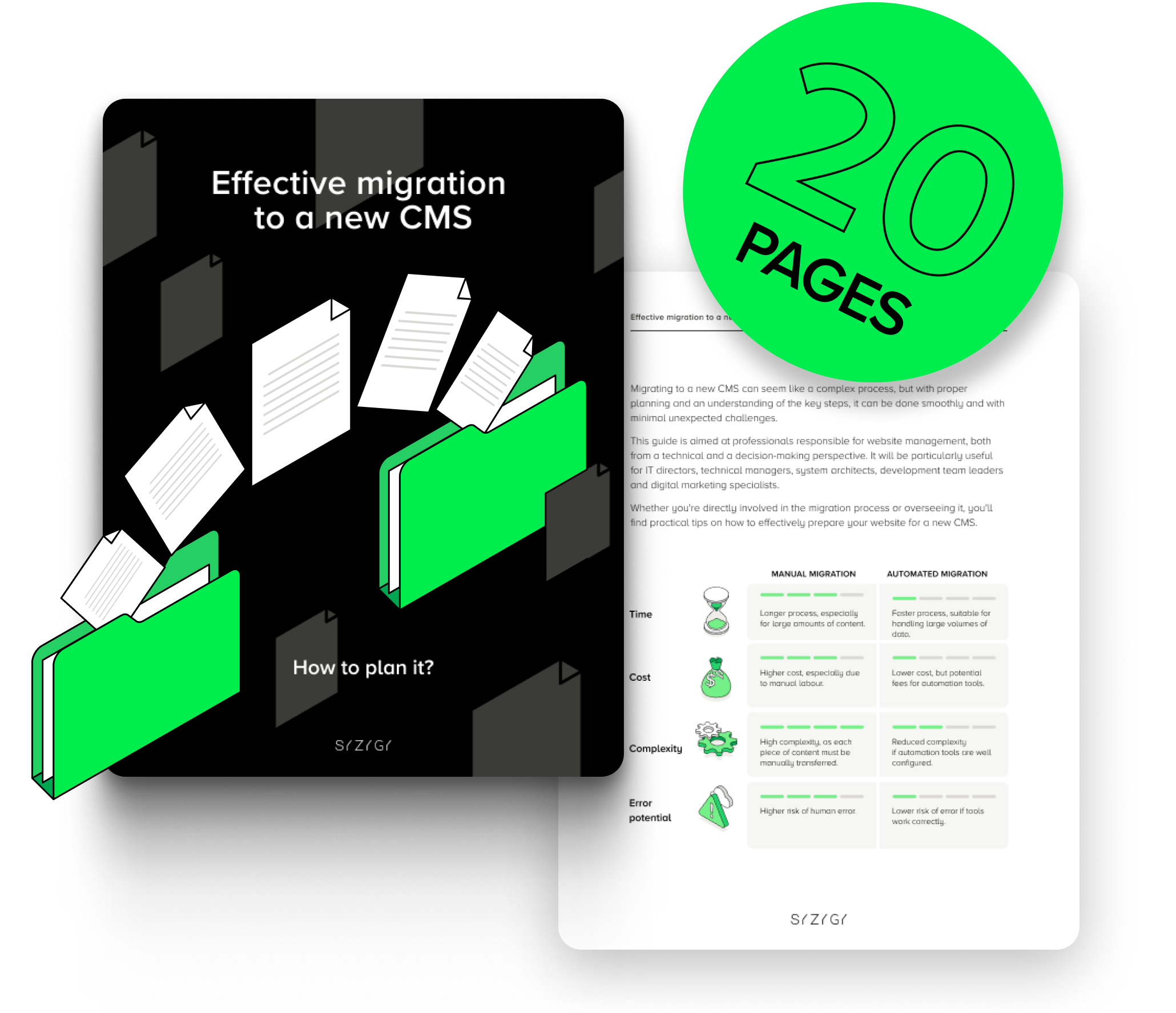
Are you planning to implement Contentful CMS? Download the practical guide!
Before you start, find out how to effectively plan your migration to the new CMS. Download the free PDF e-book 📄 and learn how to perform a step-by-step audit, avoid data migration errors, and ensure the security and performance of Contentful CMS.
